
- Home
- PRODUCT CENTER
- ABOUT US
- BLOG
- Application
- FAQ
- CATALOGUE
- Contact Us
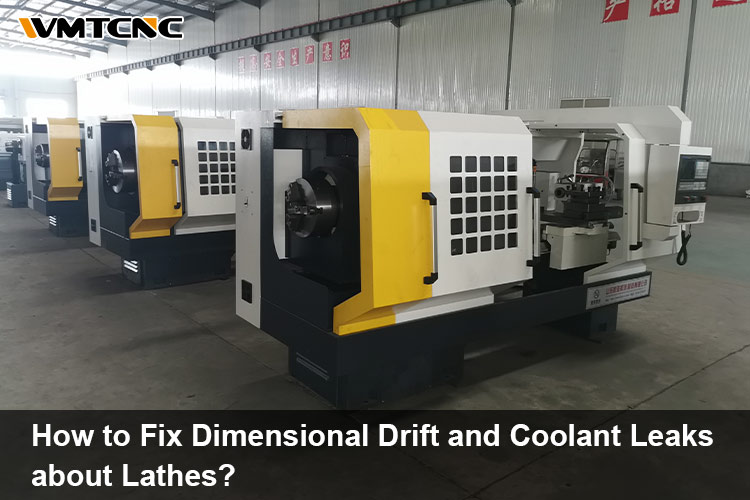
Product quality and production efficiency are directly impacted by the stability and machining accuracy of machine tools in the fundamental processes of contemporary manufacturing. However, machine tools unavoidably experience some malfunctions during regular use. Ensuring continuous production requires quickly identifying problems and putting effective fixes in place. Cutting fluid leakage and unstable machining dimensions are two common faults for which this article offers thorough diagnostic methods and maintenance fixes.

In addition to affecting product yield rates, workpieces that display surface chatter marks or dimensional deviations during machining may also be a sign of underlying mechanical problems with the machinery.
1.Wear or excessive clearance in lead screws or guideways

Wear on lead screws or guideways from prolonged use raises transmission clearance and has a direct impact on machining precision.
Solution: Use a dial indicator to check the backlash and compensate or adjust the preload through system parameters.
2.Damaged ball screw bearings
In addition to increasing transmission resistance, damaged bearings can produce noise and vibration.
Solution: To guarantee a smooth transmission, replace the lead screw bearings as soon as possible.
3.Loose Coupling
Machining deviations are caused by sporadic power transmission caused by loose coupling connections.
Solution: Turn off the machine, check the coupling screws, and tighten them.
4.Machine Leveling Issues

Machine leveling imbalance brought on by foundation settlement or extended vibration can reduce geometric accuracy.
Relevel the machine tool and tighten the anchor bolts as a solution.
Lubricate and check the transmission system on a regular basis. To proactively avoid problems, create equipment maintenance records that include usage hours and the frequency of critical component replacements.

Cutting fluid leaks can lead to inadequate machine tool lubrication, accelerate equipment wear, and even cause electrical malfunctions in addition to wasting resources and polluting the environment.
Every month, thoroughly inspect the cooling system, paying particular attention to the state of the water pump, fittings, and seals. To greatly increase component lifespan, choose sealing materials that are resistant to aging and corrosion.

Regular preventive maintenance is more crucial than reactive repairs in order to avoid the aforementioned failures. We advise users to:
Timely troubleshooting and scientific maintenance are essential to the reliable operation of machine tools. The service life of machine tools can be greatly increased in addition to reducing equipment downtime through routine inspections and preventive maintenance. We are dedicated to offering thorough technical support and full after-sales service as a professional machine tool manufacturer to help you optimize production efficiency and profitability.
Please do not hesitate to contact WMTCNC’s professional technical team at any time for additional technical consultation or maintenance services.
BT tapers (BT30/40/50) offer symmetric design for high rigidity and compatibility with autocheckers; SK tapers follow DIN 69871, excel in concentricity and high-speed stability—choose based on machining needs and regional support.>> Read more
Shaper machines utilize a reciprocating single-point cutter to shape flat surfaces, grooves, and profiles. Available in crank, hydraulic, vertical, universal, and traveling-head types, they excel in heavy-duty, precise, short-run tasks and are increasingly adapted with CNC retrofits.>> Read more
Slant-bed CNC lathes offer enhanced rigidity, chip removal, and precision. With 30°, 45°, and 60° bed options tailored for small parts, versatile machining, or heavy-duty tasks, they outperform flat-bed models in stability and efficiency.>> Read more
CNC automation leverages digital control to streamline machining for precision, speed, and cost-efficiency. By replacing manual input with CAD/CAM-driven G-code, modern CNC systems drive consistent, high-volume production.>> Read more
DC motors offer precise speed and high starting torque for robotics and EVs but need maintenance. AC motors are rugged, low-cost, with long lifespan—ideal for HVAC, industrial machinery, and appliances.>> Read more


Tags: Lathes
