
- Home
- PRODUCT CENTER
- ABOUT US
- BLOG
- Application
- FAQ
- CATALOGUE
- Contact Us
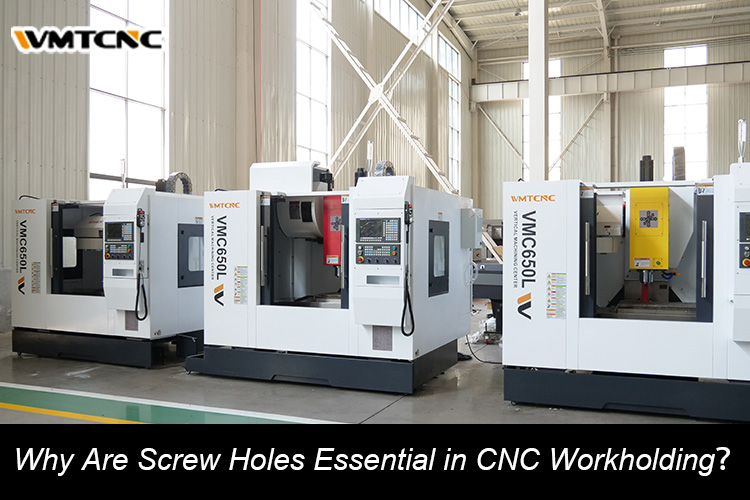
Workholding is the invisible cornerstone of CNC machining. No matter how complicated the spindle or software is, accuracy collapses in the absence of stable clamping. One of the most crucial—yet frequently overlooked—features of machining centers is the screw holes in the worktable. These simple threaded points serve as anchors for workpieces and fixtures, offering stability, adaptability, and scalability.
Additionally, both cutting and non-cutting CNC machine tools are enhanced by workholding techniques. By understanding both elements together, manufacturers can achieve improved performance, consistency, and competitiveness.

For large, rigid components, the workpiece can be securely fastened against the table by inserting bolts directly through the screw holes. This method preserves dimensional accuracy by keeping the piece from moving under heavy machining loads.
When dealing with smaller or more intricate parts, direct clamping is impractical. Instead, machinists attach fixtures such as angle plates, modular bases, and vises to the table using screw holes. Then the operator secures the workpiece to the fixture. This two-step process improves efficiency, particularly in batch production, while guaranteeing accuracy for complex geometries.

In addition to clamping force, screw holes ensure repeatable alignment. By guaranteeing that fixtures or workpieces are positioned precisely in relation to the machine coordinate system, they aid in precision machining.

Standard screw-hole spacing patterns are purposefully designed to accommodate fixtures that are universal. By allowing the attachment of angle irons, clamping plates, and other standard equipment without the need for specialized drilling, this shortens setup time and boosts flexibility.
For large mold or aerospace components, a single table is often too small. Screw holes enable the expansion of the machining area by joining multiple tables or adding extension plates.
In Industry 4.0 environments, screw holes are used as mounting points for robotic interfaces, hydraulic clamps, and automated pallet systems. This flexibility supports advanced automation and lights-out machining.
A CNC machine consists of the base, spindles, motors, and control software. However, tools are the cutting or shaping instruments that actually come into contact with the material. Without them, a CNC machine is just motion control. They collaborate to create precision components.
Milling Tools (End Mills, Face Mills, Ball Nose Mills): Used for profiling, slotting, and finishing.
Turning Tools (Lathe Tools): Shape external and internal surfaces of rotating parts.
Drill Bits and Reamers: Drill precise holes and refine their finish.
Taps and Thread Mills: Create internal threads for fasteners.

Non-cutting tools are equally vital. Fixtures and clamps hold parts steady, probes ensure accuracy, tool setters ensure correct alignment, and coolant nozzles control heat.
Complexity of Parts: Multi-axis machining centers are required for aerospace or medical applications.
Material to be Machined: Titanium and Inconel demand robust spindles and rigid setups.
Cost Per Part: Balance between machine investment, tooling life, and operating expenses.
Available Space: You must consider floor layout and workflow efficiency.
Linear Motion (LM) Guide Ways: Faster but suited for lighter-duty tasks.
Box Guide Ways: Rigid, vibration-resistant, capable of heavy cuts, but slower.

Control systems must balance dependability, software stability, and usability. Automation solutions, such as automatic tool changers, further boost efficiency.
This covers mainstream vertical and horizontal models. Parameters are based on industry-standard specifications (slight variations may exist across brands; refer to equipment manuals for specifics).
| Machining Center Type | Common Worktable Dimensions (Length × Width) | Screw Hole Specifications (Metric) | Screw Hole Spacing | Compatible Bolt Types | Applications |
|---|---|---|---|---|---|
| Vertical (Small) | 500×300mm – 800×500mm | M8 – M12 | 50mm/75mm | Hexagon socket head bolts | Small parts processing, precision molds |
| Vertical (Medium) | 1000×600mm – 1500×800mm | M12 – M16 | 100mm | Hexagon socket head bolts | Batch parts, medium-sized tooling |
| Vertical (Large) | 1800×1000mm or above | M16 – M20 | 100mm/150mm | Hexagon socket flange bolts | Large workpieces, heavy fixtures |
| Horizontal (Small) | 630×630mm – 800×800mm | M10 – M14 | 80mm/100mm | Hexagon socket head bolts | Multi-faceted processing, small housings |
| Horizontal (Medium) | 1000×1000mm – 1250×1250mm | M14 – M18 | 100mm/125mm | Hexagon socket flange bolts | Box-type parts, batch complex parts |
| Horizontal (Large) | 1600×1600mm or above | M18 – M24 | 150mm/200mm | High-strength hexagon socket bolts | Heavy housings, large structural parts processing |
Efficient use of screw holes with modular fixturing reduces setup time and maximizes spindle uptime.

Proper workholding eliminates vibration and misalignment and ensures parts consistently meet tolerance requirements.
Workholding strategies supported by screw holes enable quick changeovers and just-in-time production, aligning with lean manufacturing principles.

Screw holes are surprisingly simple to use but essential on worktables used in machining centers. They guarantee precision, adaptability, and stability while effortlessly integrating with fixtures, extensions, and even intelligent manufacturing systems. When combined with the right CNC machine tools, they form the basis of production that is reliable, efficient, and prepared for the future.
BT tapers (BT30/40/50) offer symmetric design for high rigidity and compatibility with autocheckers; SK tapers follow DIN 69871, excel in concentricity and high-speed stability—choose based on machining needs and regional support.>> Read more
Lathe chucks ensure secure, precise clamping on a lathe spindle. They include types like 3-jaw, 4-jaw, magnetic, collet, and powered variants to suit varied materials and machining needs.>> Read more
CNC spindles are vital for machining functions like drilling, milling, and cutting, with diverse structural designs tailored for precision and application-specific performance.>> Read more
Shaper machines utilize a reciprocating single-point cutter to shape flat surfaces, grooves, and profiles. Available in crank, hydraulic, vertical, universal, and traveling-head types, they excel in heavy-duty, precise, short-run tasks and are increasingly adapted with CNC retrofits.>> Read more
Slant-bed CNC lathes offer enhanced rigidity, chip removal, and precision. With 30°, 45°, and 60° bed options tailored for small parts, versatile machining, or heavy-duty tasks, they outperform flat-bed models in stability and efficiency.>> Read more


Tags: Machine
