
- Home
- PRODUCT CENTER
- ABOUT US
- BLOG
- Application
- FAQ
- CATALOGUE
- Contact Us
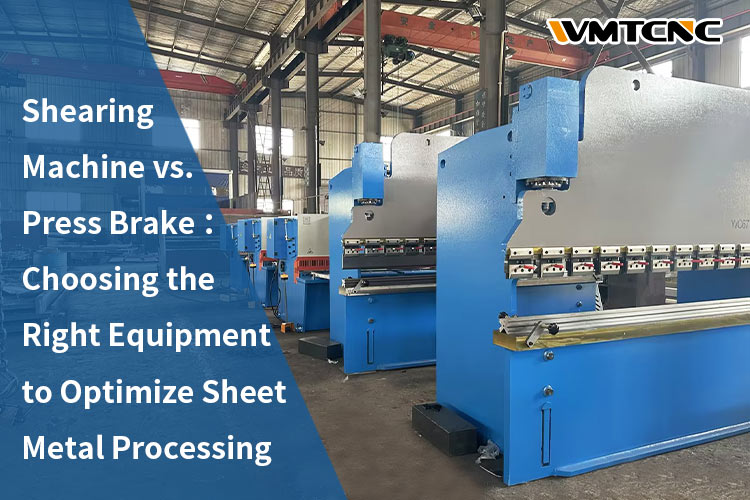
In the sheet metal fabrication industry, shearing machine and press brake are two crucial pieces of equipment, each performing distinct tasks during the manufacturing process. Shearing machines are renowned for their efficient straight-line cutting capabilities, making them ideal for rapidly processing large volumes of metal sheets. Press Brakes, on the other hand, excel at forming metal sheets into desired shapes, particularly excelling in tasks involving complex geometries and high precision requirements.
This article will provide an in-depth comparison of shearing machines and bending machines, helping you understand their core functions, suitable materials, advantages and disadvantages, and how to select the appropriate equipment based on specific requirements.
Shearing machines and bending machines are used for cutting and bending metal plates respectively, exhibiting significant differences in operating principles and application scenarios.

Shearing machines cut metal plates to desired dimensions using the shearing force of blades. They excel at rapid, precise straight-line cutting and are particularly suited for high-volume production. Widely employed in construction, shipbuilding, and metallurgy, they are especially effective for cutting large-sized metal plates like steel and aluminum sheets. Common applications include metal processing in construction, ship manufacturing, and automotive production.

Press brakes bend metal sheets to desired angles by applying pressure through an upper die. They excel in processing requiring precise angles and shapes, particularly for complex parts and small-batch production. Widely used in aerospace, automotive manufacturing, construction, and furniture industries, they are especially effective for bending high-precision metal components like aircraft hulls, vehicle body parts, and custom metal structures.

For different operational requirements, shearing machines and bending machines exhibit significant differences in their technical specifications.
| Comparison Items | Shearing Machine | Press Brake |
|---|---|---|
| Operating Principle | Uses blades to cut metal sheets | Uses upper and lower molds to apply pressure and bend metal sheets |
| Suitable Materials | Suitable for thin and medium-thick sheets, especially metals like steel and aluminum | Suitable for metals of various thicknesses, especially aluminum, stainless steel, etc. |
| Precision | High precision, suitable for straight-line cutting | High-precision bending, can be controlled to micron levels |
| Production Efficiency | High-speed cutting, suitable for large-scale production | Relatively slower, suitable for complex shapes and small-batch production |
| Application Range | Straight-line cutting, simple shapes | Bending complex shapes, angle adjustments |
| Operational Complexity | Simple operation, easy to learn | Requires higher technical skill, especially in multiple bends |
Selecting the appropriate equipment depends not only on its technical specifications; the strengths and limitations of the machinery also directly impact production efficiency and processing quality.
| Comparison Items | Shearing Machine | Press Brake |
|---|---|---|
| Advantages | – Efficient and fast, suitable for large-scale production – Simple operation, easy to learn – Suitable for straight-line cutting, saves time | – High precision, suitable for complex shapes and angle processing – Can process a variety of metal materials, versatile – Precise control over bending angles and shapes |
| Disadvantages | – Limited to straight-line cutting, cannot handle complex shapes – Limited cutting ability for thicker materials | – Relatively complex operation, requires higher technical skill – Bending high-strength materials requires higher pressure |

Shearing machines and bending machines each offer distinct advantages depending on the production task. Here are some selection recommendations:
| Demand Type | Choose Shearing Machine | Choose Press Brake |
|---|---|---|
| Large-Scale Cutting | Suitable for fast processing of large metal sheets | Not suitable, slower speed and not ideal for straight-line cutting |
| Precision Bending | Not suitable, cannot provide bending functionality | High precision, suitable for bending complex angles and shapes |
| Small-Batch Production | Suitable for batch cutting, reduces waste | Suitable for multiple bends, especially for complex part production |
| Complex Shape Manufacturing | Cannot meet requirements, cannot process complex shapes | Can precisely bend to meet complex shape requirements |
In modern sheet metal processing, shearing machines and bending machines are often used as complementary equipment. Shearing machines perform initial metal cutting, while press brakes are employed for subsequent shaping operations. Optimal equipment selection and utilization can significantly enhance production efficiency, reduce manufacturing costs, and improve product quality.
Q1: Can a press brake be used for shearing?
A1: Modern press brakes are primarily designed for metal bending, not cutting. While some press brakes can perform limited punching or cutting, their shearing capability is far inferior to dedicated shearing machines. If your primary need is cutting, a shearing machine is the more suitable choice.
Q2: Which machine is better suited for cutting thick or hard metals?
A2: Shearing machines, especially hydraulic shears, are better suited for cutting thicker or harder metals. Their hydraulic systems provide greater cutting force, capable of handling thick steel plates, stainless steel, and other hard metals. Press brakes are primarily designed for bending; while they can bend thick metal, their cutting capabilities are limited.
Q3: What is the difference between a press brake and a bending machine?
A3: Press brakes and panel benders operate on different principles. Press brakes typically use pressure between upper and lower dies to achieve precise bending of metal sheets. Panel benders (especially panel bending machines) employ simpler clamping and bending actions, making them suitable for smaller, simpler bending tasks. Press brakes handle more complex and intricate work.
Q4: How should press brakes or shears be maintained?
A4: Both press brakes and shears require regular maintenance to ensure performance. For press brakes, periodic inspections of the hydraulic system, die wear, and equipment calibration are critical. Shears require attention to blade wear, blade gap adjustment, and hydraulic system upkeep. Proper maintenance not only extends equipment lifespan but also preserves machining precision.


Tags: Sheet Metal
