
- Home
- PRODUCT CENTER
- ABOUT US
- BLOG
- Application
- FAQ
- CATALOGUE
- Contact Us
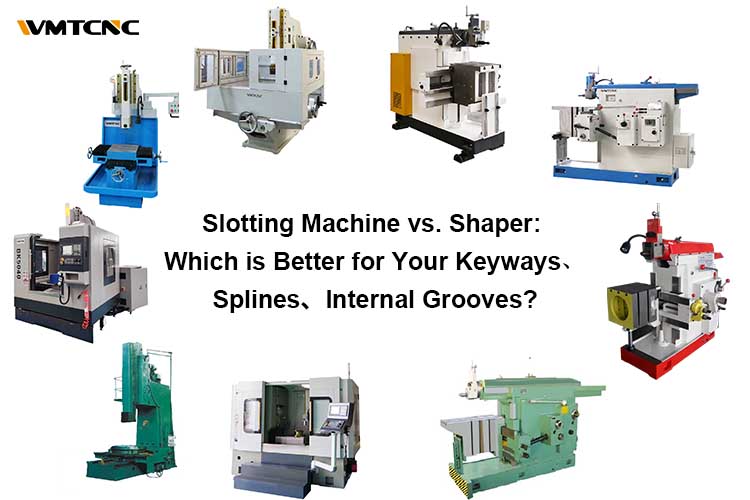
In metal cutting, both slotting machine and shaper employ reciprocating cutting with single-edge tools. Their primary motion directions, workpiece orientations, and applicable workpieces differ, leading to distinct choices for tasks like keyway, spline, and internal groove machining. This article outlines the key characteristics, operating principles, typical applications, and selection procedures for both machine types, enabling quick on-site decision-making in manufacturing environments.

The primary motion of a “slotting machine” is vertical reciprocation, with the tool moving up and down, and cutting primarily occurring during the downward stroke. The worktable can perform longitudinal, transverse, and rotary indexing feeds. It is suitable for internal features such as internal keyways, internal ring grooves, blind slots, and partial internal splines (straight-sided).
The primary motion of a “shaper” is horizontal reciprocation, with the tool cutting during the forward stroke and returning unloaded. The worktable can be raised/lowered and moved laterally. It is suitable for external features such as flat surfaces, steps, external keyways, and straight external profiles.
Both machines employ reciprocating cutting, but the slotting machine primarily targets internal features, while the shaper primarily targets external features.
To facilitate quick selection, a summary comparison of key differences between the two machine tool types is provided below.
| Dimension | Slotter (slotting machine) | Shaper (shaping machine) |
|---|---|---|
| Principal motion | Vertical reciprocating; cuts on the downstroke | Horizontal reciprocating; cuts on the forward stroke |
| Typical features machined | Internal features: internal keyways, internal ring grooves, blind slots, small-batch straight-sided internal splines | External features: flat surfaces, steps/shoulders, external keyways, long straight external grooves |
| Stroke & length capability | Limited vertical stroke; not suited to extra-long slots | Long horizontal stroke; suited to through/continuous external slots and large planes |
| Blind/closed slots | Capable | Not suitable |
| Workholding & table | Often equipped with an indexing/rotary table for bore indexing and multi-slot work | Horizontal table emphasizing clamping and support; suitable for long parts |
| Accuracy emphasis | More direct control of internal-slot position and depth | External flats and straight faces meet conventional tolerances |
| Chip evacuation & guidance | Deep, narrow internal slots require careful guidance and chip removal | Chip evacuation on external shapes is relatively smooth |
| Typical accessories/process aids | Guide bushings, internal mandrels/supports, indexing attachments | Strap clamps, angle plates, V-blocks, long-part supports |
The following provides direct selection recommendations and rationale for common tasks, facilitating rapid implementation.
| Task/Feature | Recommended Machine | Rationale |
|---|---|---|
| Internal keyway (in bore) | Slotting (slotter) | Reach inside bores; direct control of depth/width; capable of machining blind slots. |
| External keyway (on shaft / outside surface) | Shaping (shaper) | Long horizontal stroke suits through, straight grooves; simple fixturing. |
| Internal splines (straight-sided, small batch) | Slotting (slotter) | Achievable with indexing; for high volume or involute forms, use dedicated gear shaping/broaching. |
| Internal ring grooves, snap-ring grooves, closed/local grooves | Slotting (slotter) | More straightforward in confined spaces; easier to control groove-bottom position. |
| Long straight external grooves, flats, steps | Shaping (shaper) | Stroke and support better match external feature machining and alignment. |
When both machine tools can complete the same feature, the selection priorities are as follows.
Cycle Time and Stability: For external long straight lines and large flat surfaces, Shaping offers greater stability. For localized features within holes and small-area finishing, Slotting provides higher efficiency in tool change and positioning.
Position and Depth Control: For slot positions and bottom depths within holes, Slotting is more direct. For external straight lines and flatness, Shaping meets standard requirements.
Surface Finish and Finishing: Both native surfaces are suitable for general assembly. For higher surface quality or tighter tolerances, add milling/grinding finishing after slotting/planing.
Changeover Time: Both are relatively fast. Slotting offers greater flexibility for indexing, multiple slots, and blind slots. Shaping provides simpler transitions for contour trimming and continuous slots.

Deep Narrow Slots (Slotting): Add guides/internal supports, employ layered and intermittent chip evacuation to control tool deflection. Reserve bottom transition radii.
Multiple Slots/Indexing (Slotting): Use rotary/indexing tables, calibrate zero position and indexing errors. Maintain indexing records for re-measurement.
Long Parts/Large Flat Surfaces (Shaping): Employ clamping plates, V-blocks, or support blocks to prevent deflection and displacement. Verify table parallelism and end-face perpendicularity.
Gauges and Measurement (General): Inspect slot width with plug gauges/calipers; measure slot depth using depth gauges or CMM random sampling. Establish stable process references for key holes/surfaces.
The following lists only the most critical parameters affecting selection, facilitating preliminary evaluation.
| Dimension | Slotter (Slotting Machine) | Shaper (Shaping Machine) | Notes |
|---|---|---|---|
| Material hardness & heat treatment | Prefer machining before heat treatment; switch to grinding/EDM for hardened materials | Same as left | Confirm the heat-treatment sequence in advance |
| Stroke/size limits | Vertical stroke limits extra-long internal slots | Long horizontal stroke suits long slots and large flat surfaces | Verify required stroke is achievable first |
| Spline type & batch size | Straight-sided splines in small batches are feasible; involute or high volume → dedicated machines | Mainly complements external-feature operations | Consider gear shaping, broaching, or CNC slot-milling |
For single-piece, small-batch, and maintenance phases, Slotting/Shaping fulfills tasks with low tooling costs and quick changeovers. When transitioning to repetitive orders demanding higher cycle times and consistency, select upgrade paths based on feature types. Prioritize hobbing or broaching for internal keyways/splines; evaluate dedicated milling, gear hobbing, or grinding lines for external keyways/long straight external slots. Upgrade timing hinges on three criteria: cycle time becoming a bottleneck, stable repeat orders, and standardized tooth/slot profiles.

Step 1: Categorize by location. For internal features (internal keyways, internal ring grooves, blind slots, spline straight edges), select a slotting machine. For external features (external keyways, flat surfaces, steps, straight external profiles), select a shaping machine.
Step 2: Refine by target requirements. For single-piece or small-batch production with frequent adjustments, the initial selection suffices. For higher surface quality or tighter tolerances, schedule milling or grinding finishing after slotting/shaping. For higher cycle times and consistency, transition to dedicated machines or CNC solutions.
Q1: How to select machines for internal and external keyways? Are there any simple rules?
A1: Internal keyways (inside holes) → Slotting; External keyways (on shafts/outer surfaces) → Shaping. For blind slots or partially enclosed slots inside holes, slotting is generally the only option. For continuous straight external slots, shaping offers better stroke matching and simpler clamping.
Q2: How to address substandard surface quality?
A2: First optimize tool sharpness, cutting fluid, feed rate, and depth of cut. Implement rough-finish two-stage cutting when necessary. For critical surfaces, add milling or grinding finishing after broaching/planing. Ensure proper chamfering and deburring to prevent assembly interference.
Q3: What tolerance and consistency levels can be achieved for both processes?
A3: Under typical shop floor conditions, slotting offers more direct control over feature position and depth within holes, yielding better consistency. Shaping can meet general assembly requirements for external flat and straight surfaces. For tighter tolerances, schedule subsequent finishing operations or use dedicated/CNC machines.
Q4: What material restrictions apply? How should heat treatment sequencing be determined?
A4: Common metals and engineering plastics (carbon steel, cast iron, aluminum, copper alloys, stainless steel, engineering plastics, titanium, etc.) are suitable. For high-hardness materials, prioritize slotting/planing before heat treatment. If post-heat-treatment machining is required, consider grinding or EDM (Electrical Discharge Machining) first.
Q5: What are key points for daily maintenance and safety?
A5: Regularly inspect guideway lubrication, lead screw clearance, and rapid return mechanisms. Keep the worktable and fixtures clean and free of chips. Set reasonable travel limits and perform test cuts after changeovers. Ensure guards and emergency stops are functional. Adhere to shutdown protocols for chip removal and tool changes.


Tags: Shaper Machine, Slotting Machine
