
- Home
- PRODUCT CENTER
- ABOUT US
- BLOG
- Application
- FAQ
- CATALOGUE
- Contact Us
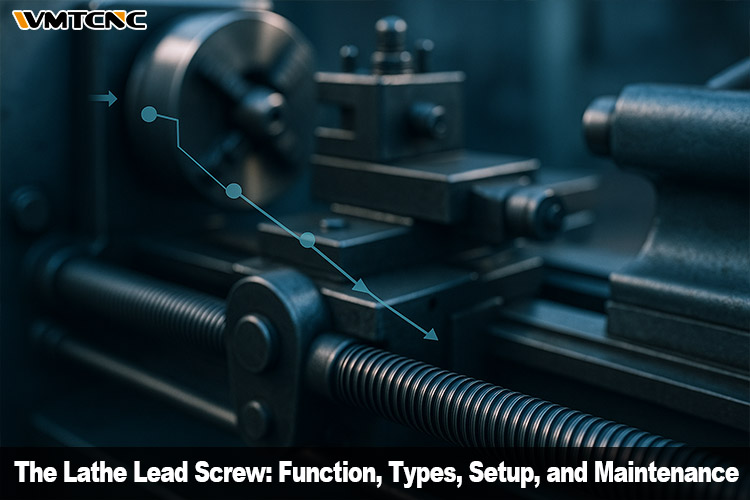
For more than a century, the lead screw has sat at the heart of accurate turning. It looks humble—a long threaded shaft running parallel to the bed—but it is the backbone that converts rotary motion into controlled linear travel. Whether you are single-point threading a shaft, chasing a delicate pitch on a thin-wall tube, or dialing in a fine finishing feed, the lead screw makes that motion repeatable and predictable. Even in the age of servo-driven CNC and linear motors, the principles that made lead screws indispensable still govern how we cut precise threads and achieve uniform surface finishes.

In plain language, a lathe lead screw is a threaded rod that drives the carriage in a straight line. As the spindle turns, a gear train sets a fixed ratio between spindle rotation and lead-screw rotation; the lead screw’s thread then transforms that rotation into linear motion. The result: the cutting tool moves an exact distance per revolution of the workpiece—precisely what you need for threading and fine feeds.
The lead screw is usually Acme or trapezoidal form for strength and serviceability. It engages with a split pair of half-nuts mounted in the carriage; when you close the half-nuts, the carriage locks onto the screw and follows it. Depending on the lathe, a separate feed rod may handle ordinary turning feeds to spare the lead screw from unnecessary wear.
The spindle’s motion passes through a gear train or quick-change gearbox to the lead screw. Because that ratio is fixed by gear selection, the carriage advances a predictable distance for each spindle revolution—your thread pitch or your feed rate, depending on the mode. The carriage rides on the bed ways, the cross-slide sets diameter, and the compound can be set for taper or the classic 29° method on 60° threads.
The half-nuts clamp onto the screw to engage the carriage. A thread dial indicator (on many imperial lathes) shows safe re-engagement marks so the tool picks up the thread accurately after backing out. The quick-change gearbox lets you switch pitches and feeds without swapping individual gears, dramatically speeding setup.

On many engine lathes, the lead screw is reserved for threading; the feed rod handles longitudinal and cross-feeds for general turning. This division preserves the precision of the lead screw and reduces wear on the half-nuts. On simpler machines without a feed rod, the lead screw may be used for both—convenient, but it increases wear and backlash risk over time.
Cutting a thread demands strict synchronization between spindle rotation and tool advance. The lead screw provides that link, translating a charted gear ratio into the specific pitch you require. Without a sound lead screw and half-nut engagement, pitch error and drunken threads are inevitable.
Although many lathes leave general feeding to a feed rod, the lead screw (or ball screw in CNC machines) shines at fine feed rates. The smoother and more consistent the linear motion, the better your surface finish—especially on materials that show feed lines.

Traditional lead screws exhibit self-locking: static friction resists back-driving under cutting loads. That trait helps hold position in manual machines. Ball screws, by contrast, have very low friction; they can be back-driven and typically require braking or servo holding torque—excellent for CNC, but different in feel and safety behavior.
| System | Purpose | Friction | Accuracy/Repeatability |
|---|---|---|---|
| Lead screw (Acme/Trapezoidal) | Convert spindle ratio to linear motion; thread cutting; fine feeds | Higher | Moderate–High (depends on wear) |
| Ball screw | Servo-driven precision axes | Very low | Very High |
| Feed rod | General feeds via clutches and gear train | Moderate | Moderate |
Takeaway: For manual threading and fine feeds, a well-kept lead screw is excellent. For CNC positioning, ball screws dominate. A feed rod is your workhorse for general turning feeds, sparing the lead screw from wear.

Start at the gear chart. Select gears or gearbox settings that match your desired pitch. Double-check the lead screw’s own pitch—imperial vs metric—so your combination produces the correct result. Verify your compound angle (commonly ~29° for 60° profiles), set a shallow first pass, and confirm synchronization with a dry run.
Engage the half-nuts at the correct thread dial mark (imperial machines) so re-engagement aligns perfectly. On metric threads without transposing gears, keep the half-nuts engaged continuously and reverse the spindle to maintain registry. Lock the carriage when appropriate and keep the tool sharp, correctly centered, and rigidly held.
Make a scratch pass and measure with wires or gauges. Back out, return, re-engage at the proper mark, and proceed in small depth increments. Maintain chip control and never reach over a rotating chuck. For thin-wall parts, use steady rests and conservative depths to avoid deflection.

Sliding contact between screw and nut gradually wears both, creating backlash—lost motion when reversing direction. You’ll feel it as delay before the carriage moves. Measure backlash with an indicator; if excessive, adjust the nut (on split-nut designs) or replace worn half-nuts. Excess backlash shows up as thread pitch error and poor finishes.
Improper mounting, bent screws (from crashes), or worn support bearings introduce tight spots and torsional variations. Check runout on V-blocks, verify axial play, and inspect support bearings. A bent screw kills finishes; replace rather than fight it.
Chips, dust, and dried coolant paste act like lapping compound. Clean the screw regularly and keep wipers intact. Use the oil grade recommended by the OEM (common shop practice: ISO VG 68–100 way/lube oils), apply lightly but consistently, and keep the gear train oil fresh.
Maintenance cadence (practical): brush and wipe every shift; oil daily; inspect backlash weekly; measure cumulative pitch error and check alignment quarterly. Document readings so you can predict when service is due.

Common choices include hardened steel screws with bronze nuts for good wear behavior, or stainless where corrosion is a concern. Material pairing matters: dissimilar hardness and good lubrication minimize galling.
Nitriding, hard chrome, and solid lubricants reduce friction and extend life. Some designs incorporate lube grooves or felt wicks to feed oil uniformly—simple upgrades that pay back in accuracy and longevity.
Beyond visual condition, quantify performance. Measure cumulative pitch error over a known travel (e.g., 300 mm/12 in). Track backlash at multiple carriage positions. If you’re buying new, ask for the screw’s tolerance class and inspection report.

The lead screw’s genius is its simplicity: a threaded shaft that turns synchronized rotation into straight-line precision. In manual lathes, it synchronizes thread cutting, enables fine feeds, and—when cared for—delivers decades of accurate service. In CNC, the philosophy persists through ball screws and servo control, achieving repeatability that would have been unimaginable on early engine lathes. Master the thread forms (Acme, trapezoidal, square, buttress, and ball screws), apply disciplined maintenance, measure backlash and pitch error, and choose materials and coatings that match your environment. Do these things well, and your lathe will produce threads that gauge perfectly and finishes that sell your craftsmanship.
Conventional lathes offer manual operation suitable for small-batch, low-precision tasks, while CNC lathes provide high precision, efficiency, and automation for large-scale, complex production. CNC lathes reduce labor dependency and enhance consistency.>> Read more
The article discusses various machining methods for shapes like spheres, crankshafts, tapers, and threads, along with material-specific strategies for hard steel, stainless steel, titanium, and rubber, focusing on tools, techniques, and best practices for optimal results.>> Read more
Explains key lathe machine specs—swing, centers, travels, power—and how they affect capacity, rigidity, and accuracy for smarter buying and setup.>> Read more
Lathe chucks ensure secure, precise clamping on a lathe spindle. They include types like 3-jaw, 4-jaw, magnetic, collet, and powered variants to suit varied materials and machining needs.>> Read more
CNC automation leverages digital control to streamline machining for precision, speed, and cost-efficiency. By replacing manual input with CAD/CAM-driven G-code, modern CNC systems drive consistent, high-volume production.


Tags: Lathe lead screw, Lathes
