
- Home
- PRODUCT CENTER
- ABOUT US
- BLOG
- Application
- FAQ
- CATALOGUE
- Contact Us
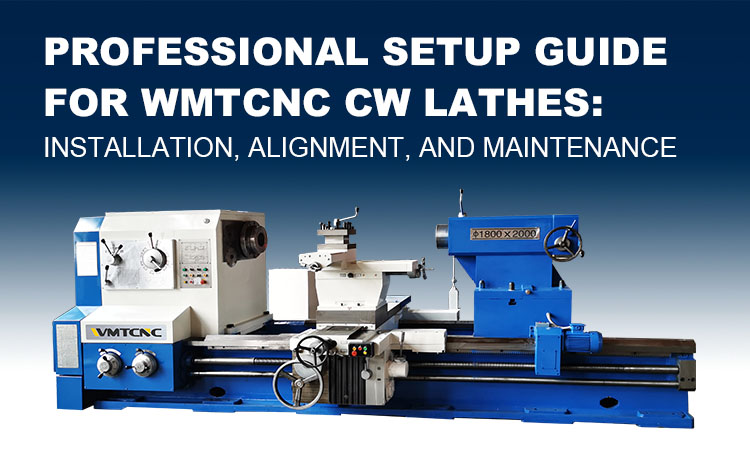
Welcome to the WMTCNC CW Lathes Installation and Commissioning Manual. This comprehensive guide is designed to help new owners and technicians safely install, set up and optimize your WMTCNC CW Series Heavy Duty Lathe. Proper installation is critical – it will ensure your lathe delivers the legendary precision and reliability for which WMTCNC is known. The following sections provide step-by-step instructions and best practices for unpacking, site preparation, electrical setup, test runs, and maintenance. Following these guidelines will not only get your lathe up and running smoothly, but will also give you the confidence that your machine is set up for long-term performance.

Carefully unpack the lathe from the shipping crate, noting any “top” or “center of gravity” markings on the packaging. Use a forklift or crane of sufficient capacity (the CW Series lathes are very heavy), and lift from the designated lifting points to avoid damaging the machine. As you unpack the machine, compare the contents to the packing list provided by WMTCNC to ensure that all parts, accessories and documentation are present. Perform a thorough visual inspection of the exterior and components of the machine for any signs of damage that may have occurred during shipping. If you find any problems or missing items, report these to your WMTCNC representative before proceeding
Welcome to the WMTCNC CW Series Lathe Installation and Commissioning Guide. This comprehensive guide is designed for new owners and technicians to safely install, set up, and optimize your WMTCNC CW Series Heavy Duty Lathe. Proper installation is critical – it will ensure your lathe delivers the legendary precision and reliability for which WMTCNC is known. The following sections provide step-by-step instructions and best practices for unpacking, site preparation, electrical setup, test runs, and maintenance. By following these guidelines, you will not only get your lathe up and running smoothly, but you will also have the confidence that your machine is set up for long-term performance.

Installing your lathe in a suitable location is essential for both accuracy and safety. Choose a location that meets the following environmental and foundation criteria:
The installation location should be indoors, dry and temperature controlled. The ideal ambient temperature is approximately 5-40°C. Avoid extreme temperature fluctuations that may affect the accuracy of the machine. The relative humidity should be moderate (ideally ≤ 75% non-condensing) to prevent condensation and rust. The location should be free from corrosive airborne substances or excessive dust. Also, avoid direct sunlight or heat sources directed at the lathe, as uneven heating may cause expansion and affect alignment.
The CW Series lathes are heavy duty machines that require a solid, level foundation. Be sure that your floor can support the weight – for larger CW models, this can be several tons. A reinforced concrete foundation is recommended. If the manufacturer has provided foundation drawings and specifications, prepare the floor accordingly. In many cases, the WMTCNC lathes can simply be placed on the floor with leveling pads or wedge blocks at designated points.

Before the lathe is started for the first time, all lubrication systems must be inspected and primed. CW Series lathes typically have multiple lubrication points, including an oil reservoir in the headstock, an oil sump for the feed gear, and various grease or oil points for the leadscrew and tailstock. Proper lubrication is essential for the longevity of your machine – running the lathe without adequate oil can cause serious damage to bearings and gears.

Refer to the lubrication chart or the section in your WMTCNC manual to identify all lubrication points. The table below summarizes the major components and the recommended oil specifications:
Component Recommended Lubricant & Grade Notes
Headstock (Spindle Gearbox) High-quality gear oil, ISO VG68 (46# in cooler climates) Fill to the sight gauge level. Contains pump for pressurized lubrication. Oil pressure should be ~1.0 MPa at running speed.
Feed Gearbox / Apron Machine way oil or hydraulic oil, ISO VG46 Splash or pump lubrication. Check weekly oil level. Change oil annually.
Bed Ways & Carriage Slideway oil (ISO VG68 way lube) Lubricate sliding surfaces daily. Apply a light film of oil to prevent rusting.
Lead Screw & Tailstock Multipurpose grease or way oil Grease the leadscrew bearing and tailstock quill periodically.
Once the machine is mechanically in place and lubricated, the next step is to connect the power and perform electrical and safety checks. While the CW Series lathes are often “manual” in operation, they still have electrical systems for the spindle motor, pumps, and possibly a DRO or CNC control, depending on the model. Correct electrical connection and safety checks are essential prior to any test runs.
Check the voltage and phase required for the lathe. Most WMTCNC CW lathes are three-phase machines (usually 380V or 400V AC in many areas, or sometimes 220V three-phase). Check the machine’s nameplate or documentation for the exact requirement. Make sure that the power supply in your workshop matches these requirements. Never connect a machine to a higher voltage than specified.
Carry out a safety interlock and functional check list before the first full operation. Test the emergency stop function, the limit switches and the mechanical movement before the first full run.
Now that the lathe has been installed, leveled, lubricated and checked electrically, it is time to perform the first commissioning test run. The goal here is to run the machine under no-load conditions to make sure all systems are working properly (lubrication, cooling, feeds, etc.), and then to perform accuracy checks. Proceed step by step and don’t rush into heavy cutting until these tests are completed.

Commissioning isn’t the end of caring for your machine-it’s the beginning of a regular maintenance routine that will keep your lathe running optimally for years to come. WMTCNC lathes are built to last, but routine maintenance is essential to maintain performance and avoid downtime. We recommend the following preventive maintenance procedures:
•Clean the machine of chips and debris.
– Wipe and oil the sliding surfaces.
– Check the oil level daily.
– Lubricate key points as needed.
•Weekly: Check and clean the machine. Check gibs and bolts for tightness.
-Monthly: Check gibs and bolts for tightness: Check machine levelling. Change lubricating oil as necessary.
– Annually: Change filters, inspect electrical components.

In summary, the proper installation and start-up of a WMTCNC CW Series lathe is a step-by-step process that will ensure you get the most out of your investment. By following this guide – carefully unpacking the machine, placing it on a solid, level foundation, checking lubrication, checking electrical safety, and methodically test running the lathe – you will set the stage for trouble-free operation.

The CW Lathe machine can perform various turning work, such as end face, external cylindrical surface, turning inner holes, cutting of various threads in Metric, Whitworth, Module, Diametral threads, etc. of the various workpieces…… >> Read more
Lathe machines are essential tools in machining operations, used to shape material by rotating the workpiece against cutting tools. They are versatile, capable of performing a wide range of operations such as turning, threading, facing, and drilling. This article explores how to specify…… >> Read more
A lathe machine is a fundamental tool in metalworking, used to shape, drill, and thread materials with precision. This guide introduces its key components, basic operations, and essential safety and maintenance practices to help…… >> Read more


Tags: CW Lathe, Lathe Machine
