
- Home
- PRODUCT CENTER
- ABOUT US
- BLOG
- Application
- FAQ
- CATALOGUE
- Contact Us
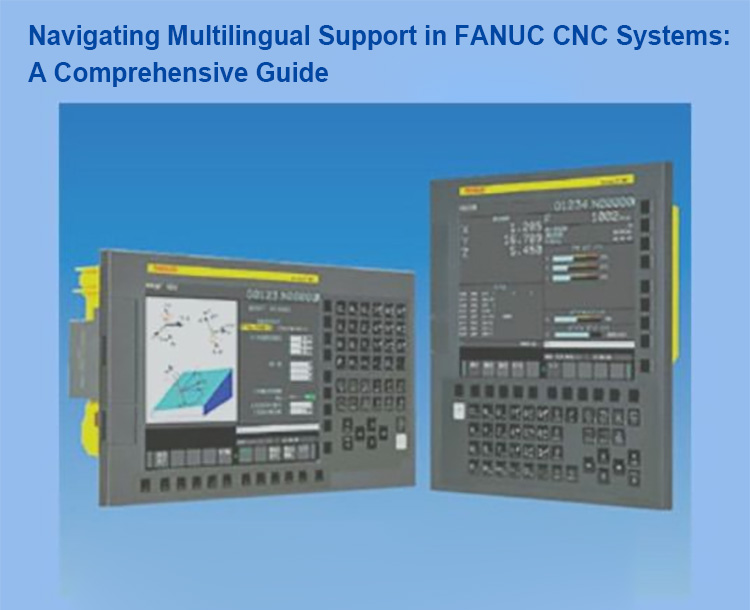
FANUC, one of the world’s leading manufacturers of computer numerical control (CNC) systems, is renowned for its precision, reliability and adaptability. A critical feature that underscores its global appeal is its robust multi-language support, which enables seamless operation in diverse language landscapes. So, this article delves into the intricacies of language support in FANUC CNC systems, exploring the range of languages supported, differences between system models, methods for switching languages, and practical considerations for operators and manufacturers.

FANUC CNC systems are designed with a global user base in mind, and offer support for a wide range of languages. According to the official documentation, the systems support 21 languages, each of which is identified by a specific language code:
| Language Code | Language |
| 0 | English (Default) |
| 1 | Japanese |
| 2 | German |
| 3 | French |
| 4 | Traditional Chinese |
| 5 | Italian |
| 6 | Korean |
| 7 | Spanish |
| 8 | Dutch |
| 9 | Swedish |
| 10 | Finnish |
| 11 | Czech |
| 12 | Hungarian |
| 13 | Polish |
| 14 | Brazilian Portuguese |
| 15 | Simplified Chinese |
| 16 | Russian |
| 17 | Turkish |
| 18 | Thai |
| 19 | Danish |
| 20 | Norwegian |
| 21 | Arabic |

– Language support: Multi-language support is enabled by default for these models.
– Usage scenario: Commonly used in small to medium machining centers and lathes, especially in regions where language flexibility is required.
– Language support: These models support English as standard. Additional languages require the purchase of a ‘language display function’ module.
– Usage scenario: Often found in imported equipment; users may need to coordinate with FANUC or authorized distributors to upgrade language support.
– Language support: Similar to the A-series, non-English languages require additional configuration or licensing.
– Application scenario: For use in advanced manufacturing environments where specific language support may be required.


– Older models (e.g. FANUC 10M, 11): Language changes may require entering the Initial Program Load (IPL) mode and changing parameters in hexadecimal format.
– Operator messages: Some messages are embedded in the ladder logic of the PMC and may not change with the system language setting.
The ability to switch languages on FANUC CNC systems provides several practical benefits:
– Enhanced accessibility: Operators can work in their preferred language, which reduces training time and errors.
– Worldwide deployment: Manufacturers can use the same equipment in different regions without language barriers.
– Customisation: Systems can be customized to meet specific language requirements, improving overall efficiency.

FANUC’s commitment to multi-language support in its CNC systems underscores its commitment to serving a global marketplace. By understanding the language capabilities of different system models and the methods for switching languages, operators and manufacturers can ensure seamless operation in diverse language environments.
In the machining industry, the most commonly used systems for CNC machine tools are these: Japan FANUC CNC system, Germany Siemens CNC system, Japan Mitsubishi CNC system, Germany HEIDENHAIN CNC system and so on. Below we will introduce the CNC machine system for…… >> Read more
Picking the right machine tools supplier is a big deal for manufacturing or engineering businesses. The supplier you pick will have a big impact on how efficient and productive your business is, as well as on its long-term success…… >> Read more


Tags: FANUC CNC Systems
