
- Home
- PRODUCT CENTER
- ABOUT US
- BLOG
- Application
- FAQ
- CATALOGUE
- Contact Us
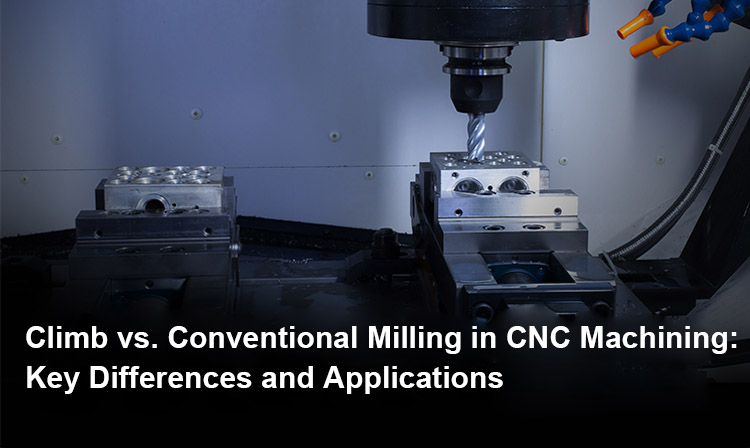
CNC milling is a vital machining process that is employed across various industries to manufacture complex parts with exceptional precision. A crucial decision in milling operations is whether to utilise climb milling or conventional milling. While both techniques achieve material removal, they differ in their cutting approach, impact on workpiece quality, and suitability for different materials.
This article provides a comprehensive analysis of climb and conventional milling, highlighting their respective advantages and disadvantages, and identifying their optimal applications. By understanding these techniques, machinists and manufacturers can optimise CNC machining processes for efficiency, accuracy, and surface finish.
CNC (Computer Numerical Control) milling is a subtractive manufacturing process where a rotating cutting tool removes material from a fixed or moving workpiece. This process enables precise shaping of metals, plastics, and composites, creating complex geometries with high repeatability. CNC milling can be performed on machines with multiple axes (3, 4, 5, or more), allowing for intricate designs.
The interaction between the cutter and workpiece determines the milling style.
In conventional milling, the cutter rotates in the opposite direction to the feed. The cutting tool starts at the bottom of the cut and moves upward, removing material in a process that appears to be at odds with the feed motion.
Ideal for manual machining or older CNC machines with backlash issues.
Best for harder materials like cast iron and hot-rolled steel.
Useful for situations where precise control over cutting force is necessary.
In the process of climb milling, the cutter rotates in the same direction as the feed. The cutting tool enters from the top and moves downward, allowing the tool to “climb” into the material.
| Feature | Conventional Milling (Up Milling) | Climb Milling (Down Milling) |
|---|---|---|
| Cutting Direction | Against the feed direction | With the feed direction |
| Chip Formation | Starts from zero width and increases | Starts from maximum width and decreases |
| Surface Finish | Rougher due to recutting of chips | Smoother, better surface finish |
| Cutting Forces | Higher, may cause workpiece lifting | Lower, presses workpiece down |
| Heat Generation | More heat, affects tool life | Less heat, improves tool life |
| Backlash Concerns | Less affected by backlash | Requires minimal backlash in machine |
| Suitability | Hard materials, manual machines | Soft materials, modern CNC machines |
| Risk of Chatter | Lower, more stable cutting | Higher if machine has backlash |
Choosing between conventional and climb milling depends on several factors, including machine capabilities, material properties, and desired surface finish.
Understanding the differences between climb milling and conventional milling is essential for optimising CNC machining performance. While climb milling offers advantages in surface finish and efficiency, conventional milling remains relevant for certain materials and machine setups. Choosing the appropriate method will improve machining accuracy, extend tool life and ensure optimum part quality.
For machinists and manufacturers, mastering these techniques and applying them correctly based on material and machine specifications will lead to better results in CNC milling operations.
Discover what a CNC milling machine is, how it works, and its key applications in modern machining. Explore its working principles, advantages…… >> Read more


