
- Home
- PRODUCT CENTER
- ABOUT US
- BLOG
- Application
- FAQ
- CATALOGUE
- Contact Us
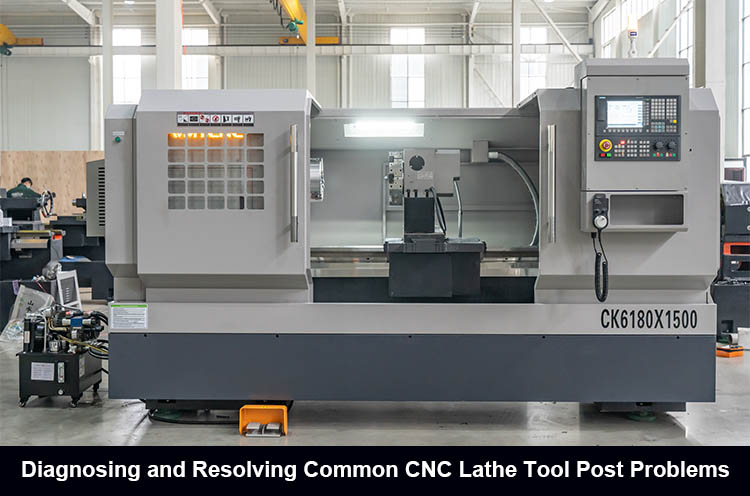
The tool post is a pivotal component of CNC lathes, enabling the execution of diverse machining operations in a single setup. This consolidation reduces machining time and minimizes errors associated with multiple workpiece clampings, thereby enhancing both efficiency and precision. However, tool post malfunctions can disrupt operations, leading to potential delays and compromised product quality. This article provides a comprehensive guide to diagnosing and resolving common CNC lathe tool post issues.

Begin by ensuring the machine is properly powered:
– Power Confirmation: Check that the machine is receiving power and that the control panel indicators are illuminated.
– Startup Issues: If the machine fails to start, inspect the power lines, circuit breakers, and emergency stop switches for any irregularities.
The phase sequence is crucial for the correct operation of the tool post motor:
– Main Spindle Operation: If the main spindle operates correctly but the tool post does not, a phase sequence error may be present.
– Correction Method: After disconnecting the power, interchange any two of the three-phase power lines (e.g., swap L1 and L2), then restore power and test the tool post.
Delve into the CNC system’s diagnostic interface to:
– Alarm Detection: Identify any tool post-related alarms, such as “tool post signal anomaly.”
– Manual Command Testing: Input manual tool change commands (e.g., T0101) to verify if the system acknowledges the command without corresponding tool post movement.
Key electrical components to assess include:
– Tool Post Motor: Utilize a multimeter to verify that the motor’s input voltage aligns with specifications (typically around 380V).
– Drive or Inverter: Examine the status indicators on the drive or inverter for signs of overloads or short circuits.
– Fuses and Relays: Inspect fuses within the tool post control circuit for any blown fuses and check relays for signs of contact sticking or damage.
Mechanical issues can significantly impact tool post functionality:
– Manual Rotation Test: With the power off, attempt to manually rotate the tool turret. Resistance or jamming may indicate insufficient lubrication, foreign object obstruction, or bearing failure.
– Sensors and Limit Switches: Verify the functionality of position detection sensors and ensure signal lines are secure and intact.
Ensure that system settings and programs are accurate:
– Parameter Verification: Confirm that tool post parameters (e.g., tool change timing, number of tool positions) are correctly configured for the specific machine model.
– Program Testing: Execute simplified tool change programs to rule out programming errors that could prevent tool post response.
A thorough inspection of the control system is essential:
– Control Board Output: Use diagnostic tools like oscilloscopes or substitution methods to verify that the tool post control board (e.g., I/O board) is outputting correct signals.
– Wiring Integrity: Check for damage or loose connections in signal cables, especially those linking the tool post motor to the controller.
Addressing common CNC lathe tool post issues promptly ensures operational efficiency and prolongs equipment lifespan. Below is a table summarizing typical problems, their potential causes, and recommended solutions:
| Symptom | Possible Cause | Solution |
| Tool post fails to lock securely | Misalignment of transmission components | Adjust the transmitting plate to align the Hall element with the magnetic steel, ensuring accurate tool positioning. |
| Continuous rotation at a specific tool position | Damaged Hall element or broken signal line | Identify the problematic tool position, test the signal with a multimeter, and replace the faulty Hall element or repair the signal line as needed. |
| Tool post does not rotate | Motor phase error or relay disconnection | Verify the three-phase power connection; correct any phase errors and check for relay overloads. |
| Tool post rotates but does not lock | Faulty motor reverse circuit or mechanical misalignment | Inspect and repair the motor’s reverse control circuit; adjust the initial position of the tool post’s mechanical components. |
| System displays position signal error | Faulty position signal board or Hall element | Detect static and dynamic parameters of the Hall element; replace the position signal board if necessary. |

Ensuring safety during CNC lathe operations is paramount. Adhere to the following guidelines to maintain a secure working environment:
– Personal Protective Equipment (PPE): Always wear appropriate PPE, including safety glasses, gloves, and hearing protection.
– Machine Guards and Fences: Ensure all protective guards and fences are in place.
– Proper Training: Operate CNC lathes only with proper training.
– Avoid Loose Clothing and Jewelry: Prevent entanglement by securing hair and avoiding accessories.
– Regular Maintenance: Conduct regular inspections to maintain safety and function.
The CNC lathe tool post is integral to machining precision and efficiency. By systematically diagnosing issues, implementing effective solutions, and adhering to stringent safety protocols, operators can ensure optimal performance and longevity of their equipment. Regular maintenance and a proactive approach to troubleshooting not only enhance productivity but also create a safer working environment.
In CNC machining, the tool turret is more than a mechanical convenience; it is a strategic component that directly influences production efficiency, part quality and operator safety. By facilitating automatic tool changes and precise tool alignment, tool turrets eliminate the need for manual intervention…… >> Read more
VDI and BMT Turret are two of the main turret systems available today.This guide to help you choose the right…… >> Read more
CNC lathes machine have totally changed how we do things by being super precise and automated. They’re awesome at cutting, shaping…… >> Read more
Selecting the right CNC metal lathe supplier is crucial for ensuring machining accuracy, production efficiency, and long-term business success. With years of expertise and a commitment to excellence, WMT CNC is a trusted global supplier of high-quality CNC metal lathes. Here’s why…… >> Read more


Tags: CNC Lathe Tool Post
