
- Home
- PRODUCT CENTER
- ABOUT US
- BLOG
- Application
- FAQ
- CATALOGUE
- Contact Us
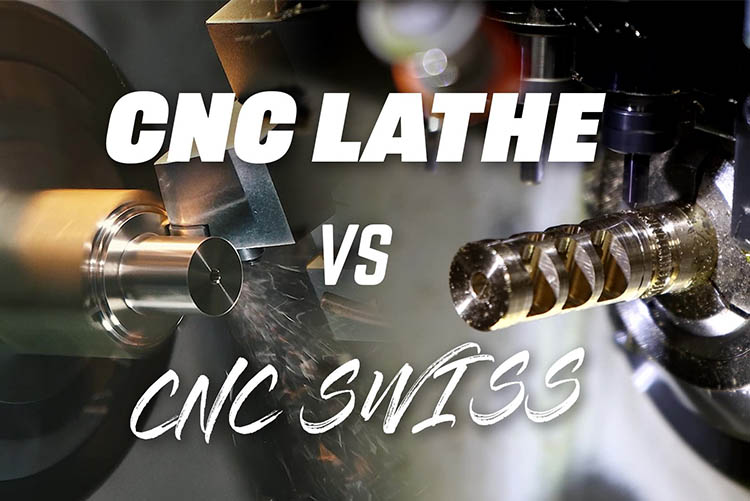

In modern precision manufacturing, choosing between a CNC Swiss lathe and a conventional CNC lathe can have a significant impact on quality, cost, and production scalability. Whether you’re machining micro-components for the aerospace industry or high-strength engine parts for the automotive sector, it is crucial to understand the core differences between these two types of lathes. This comparison highlights their distinct performance metrics and helps you make informed decisions based on specific production requirements, accuracy standards, and part geometries.
CNC Swiss lathes use a sliding headstock design with a guide bushing that allows the bar stock to move axially while being supported near the cutting point. This unique structure provides enhanced rigidity and significantly minimises deflection, making them ideal for long, slender and delicate components.
In contrast, CNC lathes hold the workpiece in a stationary spindle. The tool moves along the X and Z axes while the bar remains static. While this offers greater versatility in terms of workpiece geometry, it is more susceptible to deflection when machining long parts, which can affect dimensional accuracy.

CNC Swiss lathes carry out machining operations extremely close to the guide bushing. Material is usually fed through the bushing in segments to ensure maximum rigidity throughout the process. These machines can complete complex parts in a single cycle with simultaneous multi-axis machining, which often ranges from 7 to 13 axes, significantly reducing handling and cycle time.
In contrast, CNC lathes fix the material in place and require the tools to move around it. Machining is usually carried out in separate stages, such as roughing and finishing, and sometimes requires multiple setups, which can increase time and labour costs.

CNC Swiss lathes are designed for ultra-high precision. With tolerances as tight as ±0.0002 inches (±0.005 mm), they are ideal for industries such as aerospace, watchmaking and the manufacture of medical devices. Furthermore, using oil-based coolant enhances thermal stability, thereby reducing thermal expansion and part deformation.
In contrast, CNC lathes typically offer tolerances of around ±0.005 inches (±0.127 mm). While water-based coolants are more cost-effective, they do not provide the same level of thermal consistency, making them less suitable for ultra-precision applications.
CNC Swiss lathes boast fast cycle times thanks to their ability to complete multiple operations simultaneously. For example, a part that might take 10 minutes on a CNC lathe can often be completed in just 4 to 5 minutes on a CNC Swiss lathe. This performance advantage is particularly significant in high-volume production settings.
While CNC lathes typically have three to four axes, CNC Swiss lathes often have five or more. This extended axis control enables more complex operations to be carried out in a single pass, thereby streamlining workflows and improving throughput.
CNC Swiss lathes are excellent for machining bar stock with diameters of up to 40 mm. They are particularly well-suited to long, narrow parts made of expensive materials such as titanium or Inconel. However, they are less effective when it comes to handling large-diameter workpieces or complex castings.
CNC lathes, on the other hand, can accommodate a broader range of material shapes and sizes, including forged parts, castings, and large-diameter bar stock. This makes them a better option for shops that handle diverse component geometries.
CNC Swiss lathes, which come with a premium price tag averaging around $15,000-$100,000, are a top choice for manufacturers. In addition to this initial cost, they require more frequent maintenance due to their complex and highly sensitive internal components.
By contrast, CNC lathes are significantly more affordable, typically costing between $10,000 and $80,000. Their simpler construction and standardised components reduce maintenance time and replacement costs, making them a more accessible choice for many workshops.
CNC Swiss lathes are ideal for industries that demand extreme precision and component miniaturisation, and are used in a variety of sectors.
– Medical: surgical screws, implants
– Aerospace: fuel injectors and sensor sleeves.
– Electronics: micro-connectors and contact pins.
– Watchmaking: miniature gears and balance shafts.
Their ability to combine multiple operations in one setup results in higher efficiency and product consistency, which is especially critical in regulated sectors such as the medical and aerospace industries.
CNC lathes remain the go-to solution for:
– automotive applications, such as shafts, casings and brake components
– general engineering: pulleys and flanges
– toolmaking: large moulds and jigs.
Ideal for job shops or operations focused on larger, simpler components with moderate precision requirements, these machines are characterised by their flexibility and lower cost.
| Feature | Swiss CNC Lathe | Conventional CNC Lathe |
| Support Mechanism | Guide bushing + sliding headstock | Fixed headstock + chuck |
| Tolerances | ±0.0002 in (±0.005 mm) | ±0.005 in (±0.127 mm) |
| Axis Configuration | 7-13 axes, multi-tasking | 3-4 axes |
| Suitable Materials | Bar stock ≤40mm | Castings, forgings, large stock |
| Coolant Type | Oil-based | Water-based |
| Setup Complexity | High (requires skilled programmers) | Moderate |
| Average Cost | $15,000-$100,000 | $10,000-$80,000 |
| Maintenance | High | Moderate |
| Ideal For | Small, complex parts | Large, simple parts |
Swiss CNC machines are increasingly integrating with robotic arms. They are also integrating with AI-driven toolpath optimization. And with smart sensors. These advancements aim to boost machining efficiency. They also aim to minimise downtime. And they aim to reduce reliance on skilled labour.
Countries such as Switzerland and Germany are spearheading workforce development. They do this with dual-education models. These models train specialised technicians from an early age. Emerging markets aspiring to compete on the basis of quality must emulate such systems, aligning vocational education with the most advanced manufacturing demands.
Additionally, China’s manufacturing sector is making strides in domestic production of high-end machine components, with the aim of reducing dependency on imported spindles and control systems — an essential move toward technological self-reliance.
The choice between a Swiss CNC lathe and a conventional one depends on the complexity of your part, the dimensions of the material, the required tolerances and your budget. CNC Swiss lathes offer unmatched precision. They are indispensable for industries requiring micro-machining. CNC Swiss lathes are also indispensable for high-speed multi-axis integration.
Conversely, CNC lathes offer unparalleled versatility and value, particularly for manufacturers engaged in the production of large components or less intricate geometries. Understanding the core differences allows manufacturers to optimize operations. It also allows them to maximize returns. This is based on their specific production demands.


