
- Home
- PRODUCT CENTER
- ABOUT US
- BLOG
- Application
- FAQ
- CATALOGUE
- Contact Us
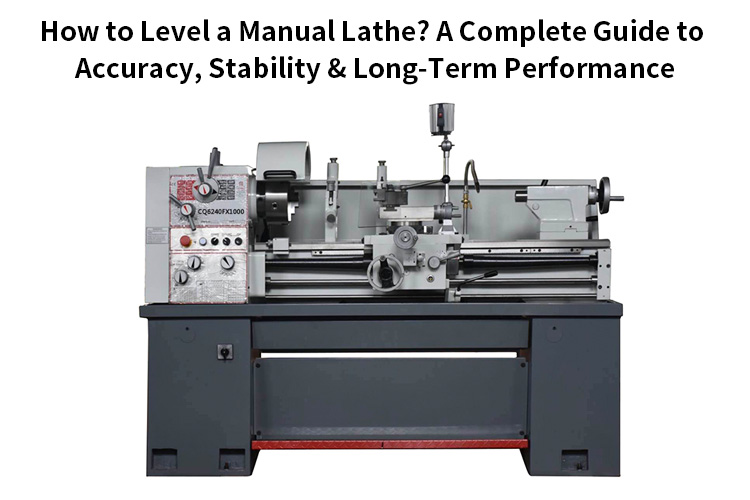
You might be running a manual lathe or a CNC lathe. Either way, the foundation determines everything. Even a slight twist or tilt in the bed can throw off the alignment between the headstock and tailstock. This misalignment causes subtle tapers and roundness errors in your workpieces.
A levelled machine operates with greater fluidity and exerts less stress on rails, bearings, and screws, thus ensuring a more protracted lifespan and a reduction in breakdowns. Moreover, when you mount the lathe on solid ground, it operates more steadily and reduces time spent scraping parts or chasing vibrations.
So, what you’ll find here is a roadmap for leveling lathe that’s pretty comprehensive, right? Whether you’re new to the process or have years of experience, it’s got everything you need to know, whether you’re a machine operator, a maintenance technician, or a production manager.
In short, whether you’re setting up a new lathe or giving an old one a tune-up, this guide helps you get the most out of your machine — and most importantly, it ensures precise, accurate results.


| Tool Category | Specific Tools | Notes |
| Precision Levels | Machinist level (±0.02 mm/m or better), optionally two | Calibrate carefully |
| Support/Jack Tools | Hydraulic jacks (2–4), steel/wooden pads | Never work under a machine supported only by jacks |
| Adjustment Tools | Wrenches, ratchets, feeler/shim stock | Recommended multiple sizes |
| Cleaning & Lighting | Rags, brushes, flashlight | Ensure clean surfaces |
| Optional for Large Beds | Laser level or optical aligner | For faster, extended spans |
| Test Bar & Indicators | Test bar, RDM or two-collar method | Used for final verification |
Position the lathe near its intended footprint and make sure it is secure. Ensure that wooden or steel pads are inserted under the feet, and then gently tighten, but do not lock them. Place your level longitudinally across the ways. These are near the headstock, centre and tailstock ends. Record baseline deviations. This baseline will help you to understand tilt direction and magnitude.
Typically, the reference point is the bed rail near the headstock, as this serves as the foundation for all measurements. To begin, clean the surface thoroughly. Place the level parallel to the rail near the headstock, and adjust the underfoot until you center the bubble.
Use hydraulic jacks to slightly lift the machine, relieve foot pressure, adjust one foot (with a jack or shim), and then lower the machine. Keep repeating the process until the reference rail falls within tolerance..
The level should be moved to the far end of the rail. Ensure that the foot is positioned so that the bubble is aligned with the headstock end. Naturally, expect some tweaks to the back and forth movement before uniform longitudinal leveling is achieved, due to mechanical interplay.
Rotate the level 90° across the bearing ways, taking care to position it near the headstock, tailstock and middle. Take note of any bubble offsets and make adjustments to the left and right foot pairs to bring the tilt back into balance. Keep in mind, earlier axes may be influenced by adjustments, so it is important to keep going through the iterative process.
Check that the headstock, tailstock, and centre all match within tolerance (≤0.02 mm/m) using alternating longitudinal and cross-axis measurements. For added confidence, utilise a test bar and execute the RDM test or two-collar turning to ascertain minimal taper (<0.0005″/in typical).
After leveling, tighten the foot bolts diagonally to avoid inducing twist. Then, re-measure all points. Lastly, run a test cut (e.g., turn a 200 mm steel rod) and measure diameters at multiple points to check for taper and roundness.

| Step | Axis | Tool | Purpose | Tolerance |
| Rough Leveling | X/Y | Machinist Level | Establish baseline | ≤0.5 mm/m |
| Reference Setup | X | Level | Set headstock end | Bubble centered |
| Longitudinal Adjustment | X | Jacks & Level | Align tailstock | Match headstock |
| Cross-Axis Adjustment | Y | Level | Adjust left/right lean | Thermally stable |
| Final Tightening | X/Y | Wrench | Secure all feet | Revalidate |
| Test Cut | X+Y | Indicator/Test Bar | Verify taper | ≤0.0005″/in |
Always calibrate and validate your levels. For best results, place them on granite, flip 180°, and zero them. Use gloves to avoid thermal distortion. Wait a few minutes after moving it for the bubbles to stabilize.
Tiny adjustments should be made — quarter turns or 0.1 mm shims, for example — and the weight should always be reset after each move. Avoid making major shifts during this stage.
Use expansion-resistant or hardened steel shims. You can use minor bed twist for compensation in older lathes, but be sure to document it.


Leveling a lathe goes beyond setup — it forms the foundation of precision machining. When done correctly, it delivers consistent accuracy, reduces mechanical stress, minimizes wear, and helps avoid production issues like taper or vibration. Although the process requires patience and attention to detail, the results include long-term stability, fewer corrections, and better-quality parts.
As a reminder, recheck the leveling any time performance declines or after moving the machine. Regular inspections and small adjustments will keep your lathe running at its best.
We are manufacturers and suppliers of industrial machinery. Our customers can always count on our support. We provide a comprehensive service for customers who purchase our machines. This includes pre-sale consultation. Additionally, it also includes guided installation and ongoing after-sales care. Our expert team ensures that every machine runs with long-term precision, stability and reliability.
New to lathe operation? This beginner-friendly guide covers everything you need to get started. From setup and safety to hands-on cutting tips and speed calculations. Master the essentials……>> Read more


